 |
| Pitheads |
WEEK 3..... PRACTITIONERS FORE, MID AND BACKGROUND, VANTAGE POINT..... Cropping and Composition
BERND AND HILLA BECHER...
 |
| Coal Bunkers |
BERND BECHER ( August 20 1931 - June 22 2007 )
German artist-photographers preoccupied with the photography of old industrial buildings in a manner related to industrial archaeology.
Bernhard Becher was born at Siegen and studied graphic art and lettering at the Stuttgart and Düsseldorf Academies. He began making paintings and lithographs of industrial structures such as iron-ore preparation plants and railway stations in 1953, influenced partly by de Chirico .He gradually became more interested in the buildings and he began to collect old photographs of them and from 1956 he decided to photograph them himself.
They are best known for their extensive series of photographic images, or typologies, of industrial buildings and structures, often organised in grids. As the founders of what has come to be known as the ‘Becher school’ they influenced generations of documentary photographers and artists. They have been awarded the Erasmus Prizeand the Hasselblad Award.

He gave up painting altogether in 1957.
Hilla Becher, born in Berlin, had studied photography in Potsdam and had worked as a photographer in advertising at the time they met. She had decided to give up advertising and start again, and had begun to study at Düsseldorf Academy, where she also taught in the photographic department. They met in 1959 and decided to work together. They began in the same year to make systematic series, at first mostly buildings in the German Ruhr and Holland; from 1965 also in Great Britain, France, Belgium, the USA etc.
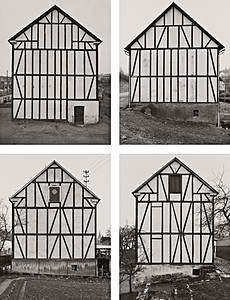 |
| Framework Houses 1988 This is a front on view. Narrow DOF |
 |
| Blast Head Furnaces. |
 |
| Winding Towers These photographs are all low vantage and they have displayed them in a spread sheet. Great idea ! |
 |
| Water Towers Low angle , narrow DOF. All these images are front on views. Im really liking this type of photography and enjoyed my exercise, shooting Bernd and Hilla Becher inspired photos. |
...................................................................................................................................................................
MY second Practitioner is
TINA MODOTTI
 |
| 1921 |
| Assunta Adelaide Luigia Modotti Mondini August 16 (or 17) 1896 Udine, Italy | |
| Died | January 5, 1942 Mexico City, Mexico |
|---|---|
| Nationality | Italian |
| Known for | Photography |
Born in Italy in 1896, photographer Tina Modotti lived an extraordinary life. Migrating as a teenager with her father to the United States, she began her working life as a textile worker. Drawn to the cultural scene in Los Angeles, she became an actor in some early Hollywood silent movies. Moving to Mexico in the 1920s, she became a contemporary of Frida Kahlo, Diego Rivera, and Julio Antonio Mella. She is portrayed in several of Diego Rivera’s murals and, as Rivera’s photographer, she photographed many of his murals as he worked and after they were completed.
Deeply involved in the revolutionary movements of her time, she fought in Spain’s Civil War in the 1930s, where she met Pablo Neruda. She later lived in the Soviet Union but found the repressive atmosphere there stifling. This edition features text in English and Spanish.
As one of the most outstanding female photographers of the twentieth century, Tina Modotti was initially trained by the iconic US photographer Edward Weston. She later developed a unique documentary style of photography. Profoundly influenced by the post-revolutionary cultural and political fervor in Mexico, she became internationally recognized for her photographs of that country. She died there at the age of forty-six.
 |
| Add caption |

 |
| Add caption |
Tina Modotti: Revolutionary Photographer,
In 1942, during a visit by her close friend, Swiss architect Hannes Meyer, Modotti died from heart failure in Mexico City under what is viewed by some as suspicious circumstances. After hearing about her death, Diego Rivera suggested that Vidali had orchestrated it. Modotti may have 'known too much' about Vidali's activities in Spain, which included a rumoured 400 executions. An autopsy showed that she died of natural causes, namely congestive heart failure. Her grave is located within the vast Panteón de Dolores in Mexico City. Poet Pablo Neruda composed Modotti's epitaph, part of which can also be found on her tombstone, which also includes a relief portrait of Modotti by engraver Leopoldo Méndez:
Examples of her work ...cropping and composition
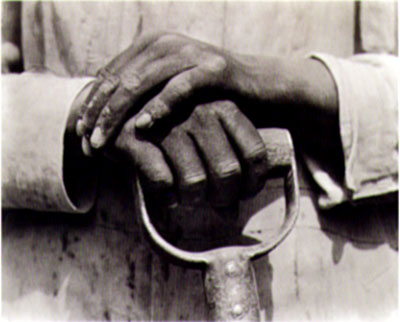
Her cropping is very effective even tho she has cropped body parts out.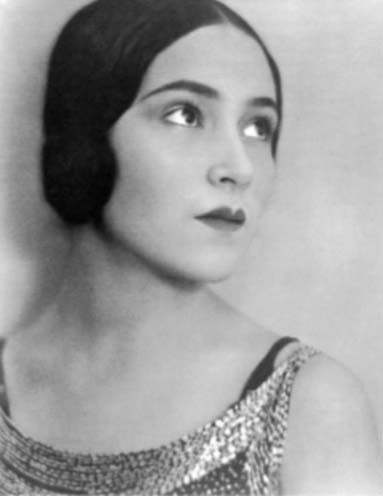

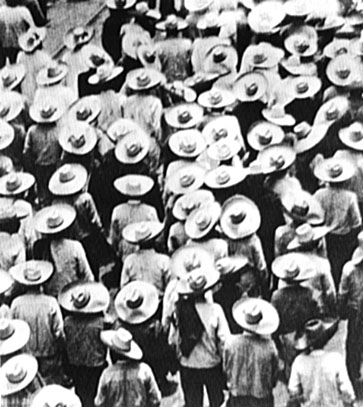


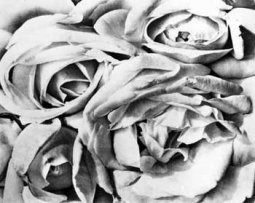
Prior to the presentation of her work in the U.S., Modotti's photographs have been shown in Italy, Poland, Germany, Austria, and other countries. The largest exhibition of her work opened at Kunst Haus Wien in Vienna on June 30, 2010. It presented 250 photographs, many never shown before. The exhibition is based on the collections of Galerie Bilderwelt, Berlin and Spencer Throckmorton, NYC and curated by Reinhard Schultz.
Tina Modotti: Photographs of Mexican Murals, April 10th - May 11th, 2015
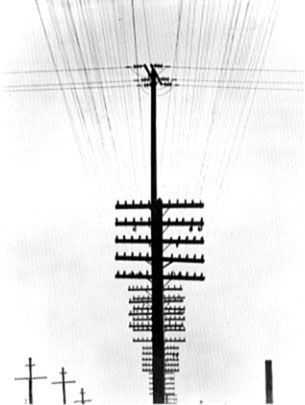
This is a great photograph by Tina. Great composition and she's taken this at a low angle. We have power lines as the foreground / mid ground the power pole and background power pole tops.
 |
| f/3.5 1/2500 ISO 100 My example |
 |
| f/4 1/250 ISO 100 |
I have taken a couple of Power pole shots which I have added to the exercise. I have looked and learnt about how Tina composed her photographs. Where she stood and took her shots. I never thought about lining all the poles up so I could get a similar shot. Will remember next time to try to get that image.
...................................................................................................................................................................


No comments:
Post a Comment