Uxbridge Creative Centre
Uxbridge Creative Centre is located in the heart of Howick, Auckland.
.jpg&width=460)
Collapse
Howick, Auckland 2014
Overview
Within the Uxbridge Creative Centre we host a diverse array of contemporary art exhibitions, art and leisure classes and workshops, cinema and a range of events throughout the year. There are rooms for hire as well as a café serving delicious coffee and food.
Uxbridge Creative Centre
35 Uxbridge Road
35 Uxbridge Road
Howick, Auckland 2014
HoursMonday - Friday: 9am-4pm
Saturday: 9.30am-2pm
JOYCE CAMPBELL:
Saturday: 9.30am-2pm
JOYCE CAMPBELL:
My research lies at the intersection between academic specialties within creative practice, science and philosophy. My recent, ongoing research project Te Taniwha, extends this interdisciplinary reach to encompass Maori mythology, while my doctoral research anticipates a further extension from photographic practices into visionary literature and film.
Underlying my interest in these divergent disciplines is a persistent questioning of the function of visual art during a time of rapidly accelerating global environmental crisis. My aim is to produce research that is simultaneously rigorous and true to several paradigms; that is both objective and opinionated, and that functions as documentary, as activism and as divination.
I am a photographer who makes images of landscapes and of objects within landscapes. Recent theorization of such photography has been dominated by assertions of the sublime as a quality of both Nature and art. At a time when Nature stumbles and fails, this analogy is becoming distended to the point of collapse.
I am attempting to theorize and visualize an ecology that is no longer overwhelming beyond imagination or speech, but rather is limited, damaged, injured and defiled, or resistant, volitional and responding with fury. To further my research goals, I have found myself turning to the sacred, the visionary and the mythological, and to primal images and experiences of the maternal body becoming animal.
Underlying my interest in these divergent disciplines is a persistent questioning of the function of visual art during a time of rapidly accelerating global environmental crisis. My aim is to produce research that is simultaneously rigorous and true to several paradigms; that is both objective and opinionated, and that functions as documentary, as activism and as divination.
I am a photographer who makes images of landscapes and of objects within landscapes. Recent theorization of such photography has been dominated by assertions of the sublime as a quality of both Nature and art. At a time when Nature stumbles and fails, this analogy is becoming distended to the point of collapse.
I am attempting to theorize and visualize an ecology that is no longer overwhelming beyond imagination or speech, but rather is limited, damaged, injured and defiled, or resistant, volitional and responding with fury. To further my research goals, I have found myself turning to the sacred, the visionary and the mythological, and to primal images and experiences of the maternal body becoming animal.
TE TANIWHA & THE THREAD 15 May – 16 July Powhiri and Exhibition Opening: Thu 14 May 6:30pm Curator's Tour: Sat 16 May and 13 June 1pm
An exhibition of Maori mythology and history from the Wairoa region. Experience loss and connection, disorientation in the photography of Joyce Campbell.
Our introduction to
TE TANIWHA
Te Taniwha is an ongoing project, drawing on the mythology, history and ecology of Waikaremoana and its many tributaries and outlets, it traces the search for two great, serpentine water species: the Taniwha and the giant longfin eel.
Joyce Campbell has been working onsite in a field darkroom to produce ambrotypes and daguerreotypes at Te Reinga, home of the Taniwha Hinekörako. Contemporary cameras do not lend themselves to the depiction of mystery. Digital cameras have made photography an increasingly descriptive medium and also one that is open to greater manipulation than ever before. By contrast, the nineteenth century techniques of ambrotype and daguerreotype provide the photographer with extraordinarily detail, depth and richness while also having an innate tendency to produce artifacts from silver and ether that are spontaneous, open to interpretation and often extraordinarily beautiful. Campbell has taken photographs of caves, gullies, pools and cascades but her hope is that in the silver we might catch a glimpse of the Taniwha as well.
|  |


Taniwha V, 2010. Fiber-based silver gelatin hand-printed photograph, 48 x 67 inches, edition of 7.
Image courtesy of the artist
Image courtesy of the artist
Te Taniwha and The Thread are two series produced through the ongoing collaboration between the photographer Joyce Campbell and Richard Niania, a historian from the Ruakituri Valley in Wairoa.
Both photographic series weave together multiple threads, drawing on the mythology, history and ecology of the Wairoa region.
great serpentines - the giant long fin eel and the Taniwha -
 |

 |
| The blessing pool |
 |
| THE SPRING |

 |
| The rock where the Hinekorako sat |

 |


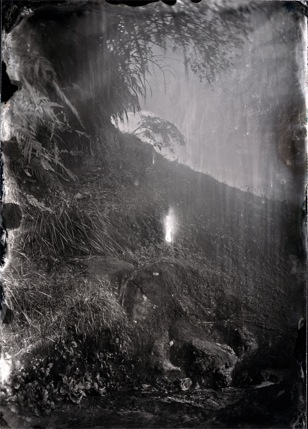 the falls with spirit flame |
 |
Joyce Campbell has been working onsite in a field darkroom to produce ambrotypes and daguerreotypes at Te Reinga, home of the Taniwha Hinekörako. Contemporary cameras do not lend themselves to the depiction of mystery. Digital cameras have made photography an increasingly descriptive medium and also one that is open to greater manipulation than ever before. By contrast, the nineteenth century techniques of ambrotype and daguerreotype provide the photographer with extraordinarily detail, depth and richness while also having an innate tendency to produce artifacts from silver and ether that are spontaneous, open to interpretation and often extraordinarily beautiful. Campbell has taken photographs of caves, gullies, pools and cascades but her hope is that in the silver we might catch a glimpse of the Taniwha as well.
THE THREAD
The Thread renders loss and connection, disorientation and reorientation with the Whakapunake Mountain as its locus.
The Thread follows on from Joyce Campbell’s exhibition Te Taniwha, a project drawing on the mythology, history and ecology of Te Reinga, and is a further expression of her collaboration with Richard Niania, He Kaipupuri Korero o Ngai Kohatu – a holder of the stories of Ngai Kohatu.
Ngai Kohatu are kaitiaki of Whakapunake maunga, the sacred mountain that rises above Te Reinga to dominate the landscape of the Wairoa region and to which the tribal groups known as Te Tini-a-Maui affiliate. The mountain’s name is derived from the word pÅ«nake meaning receptacle, and it describes the mountain as the metaphorical container for the fish hook of Maui, who is said to have foul-hooked and dragged Te Ika a Maui to the ocean surface at this site.
Eighty years ago the mountain burnt in a hunting accident from which the vegetation has never regenerated. During the first photo shoot the mountain was enveloped by dense cloud and Campbell struggled to orient herself in a field of skeletal trunks that are the remnants of the virgin forest destroyed in that disaster. When those images were developed Campbell discovered that her film had been damaged – by age, heat or radiation – so that the images already obscured by fog were further clouded by the disintegration of the material surface of the film.
The centre piece of the exhibition is The Thread, a sculpture cast in sterling silver from the roots of the Nikau Palm. Knotted and split, the thread embodies an analogy- between living systems, genealogies, and the entangled trajectories of conscious thought. Between this thread and the surrounding photographs, which are also rendered in silver, an idea emerges – to do with disorientation and reorientation, loss and connection – with the mountain as its locus.
 |
| Add caption |
 |
| Add caption |
 |
| Add caption |
 |
| Add caption |
 |
| Add caption |
These are some of my photos I took on my Iphone at the
gallery not great shots but I wanted to get the frames in for
my research as to possible ways I could present my portfolio.
 |


I really like Joyce Campbells story and photographs.
I took these photographs below early in the morning with Joyce on my mind . Looking out of my back door towards the Bombay Hills was the Valley shrouded in mist.
It looked so mystical I envisioned the Taniwha gently and quietly travelling through the Valley. A very spiritual energy .
These images are about the Valley Taniwha my version.
 |
| Joyce had a much longer process with her photographs, getting the negatives and going to process them in a dark room, with mine its done within minutes. I felt like I was cheating but to be honest for myself this works for me . Plug the cord in and download. I certainly appreciate the time and effort Joyce had put into to her images as they are truly amazing pieces of art. The korero that came with her images was very beautiful and touching. |
 |
 |
| I tried to get my image similar to Joyces by bringing in a soft edge and a frame in the left hand corner like one of her photographs above called The rock where the Taniwha sat. |
 |
| As above but in Sepia |
 |
| In these photographs I tried to give off the idea like Joyces "The Thread" Bold , ghostly and mysterious. There isn't much detail in these images because thats how I wanted to produce them. Its an early misty morning very mysterious and magical. The branches framing part of the photograph and the to the background is a lonely tree. I didnt want to copy her images but take similar images and just get the feel of how she felt in that mystical time. |
 |
| My Sepia look |
 |
| My black and white image. |
Joyce had a really great set out of her photographs some were framed and some were just hung by nails. She had her sacred photographs in the right position , I thought very respectful. A very well thought out showing.
This place is so rich with history. A place I had never seen before or even heard of.
After our very entertaining gallery experience we were shown to the Marae which was right outside the gallery. There is a beautiful path leading to the entrance, where we met the lovely Lady of the Marae Tiny.


Across the way is a tiny museum , a truly blessed place.

 |
| These beautiful treasures are held inside the old museum above. |
A great way to finish our day off.

Great photos Denise! You will need to add comments to this post in terms of evaluation and the ideas in your images.
ReplyDelete