HARUHIKO SAMESHIMA

Born 1958, Shizuoka City, Japan, emigrated to New Zealand, 1973. BFA, The University of Auckland. Widely exhibited in solo and group shows throughout New Zealand since 1982, most recently in Souvenir at the Claybrook Gallery, Auckland (1995), ), Symbolist Photography at Fisher Gallery, Auckland (1995) and Large Format Photography, Lopdell House, Titirangi, Auckland (1995). Featured in publications as diverse as Landfall, 1993 and New Zealand Home and Building, 1989 - 1995. Recipient of several awards, including a 1994 - 1995 University of Auckland Masters (Hons) Scholarship to complete his MFA at Elam School of Fine Arts. Works are held in the collections of Dunedin Public Art Gallery and the National Art Gallery (MONZ), Wellington. Lives in Auckland.

BOLD CENTURIES
PHOTOGRAPHIC HISTORY ALBUM
Haruhiko Sameshima
PHOTOGRAPHIC HISTORY ALBUM
Haruhiko Sameshima
With essays by: Kyra Macfarlane, Ingrid Horrocks, John Wilson, Tim Corbalis, Aaron Lister, Damian Skinner, Fiona Amundsen and Claudia Bell
Bold Centuries is an artist’s book by Haruhiko Sameshima – artist/photographer based in Auckland. This collage-like book is made-up of his original photographs together with found historical images and texts, both commissioned and found in history books and the Internet. It serves as an engaging and poetic introduction to Sameshima’s long standing exploration of photography as myth – a skewed tour guide and time machine, taking the reader on a meander through the histories of photographic representation in this country alongside a sweeping and contemporary canvas of our relationships with human habitats and with the land in New Zealand.
 |
| itle | Scone Ave, kitchen |
| Production | Sameshima, Haruhiko (photographer), 1981, Dunedin |
| Medium summary | black and white photograph, gelatin silver print |
| Materials | photographic gelatin, silver, photographic paper |
| Classification | black-and-white prints, gelatin silver prints, black-and-white photographs, works of art |
| Technique | black-and-white photography |
| Dimensions | Support: 405mm (Height) x 402mm (Length) |
| Credit line | Purchased 2001 with New Zealand Lottery Grants Board funds |
| Registration number | O.027360 |
I really like this image of Harus , definitely suits black and white, we have great leading lines and the image is framed with the shadow .
The title of this black and white photograph by Haruhiko Sameshima locates the image precisely. Taken in 1981, the photograph documents the kitchen of the old villa in Scone Ave, North East Valley, Dunedin, where Sameshima was living.
Animated effects
Scone Ave, Kitchen is notable for the strange perspective and distinctive dark halo that surrounds the kitchen shelf, foodstuffs, and utensils. Sameshima achieved these effects by blue-tacking a wide-angled lens from a 35 mm camera to his 4 x 5 inch Linhof camera. The black circle around the edge of the photograph was produced because the negative in the camera was larger than the circumference of the lens, while the optical effect of the wide-angle lens has distorted the objects being photographed. This is most notable in the wood panelling on the walls, and creates a slightly unsettling animation of objects like the metal teapot to the lower right of the image.
Scone Ave, Kitchen is notable for the strange perspective and distinctive dark halo that surrounds the kitchen shelf, foodstuffs, and utensils. Sameshima achieved these effects by blue-tacking a wide-angled lens from a 35 mm camera to his 4 x 5 inch Linhof camera. The black circle around the edge of the photograph was produced because the negative in the camera was larger than the circumference of the lens, while the optical effect of the wide-angle lens has distorted the objects being photographed. This is most notable in the wood panelling on the walls, and creates a slightly unsettling animation of objects like the metal teapot to the lower right of the image.
Technologies of representationThis photograph is about perception, and it evokes a kind of tunnel vision in which the edges of the image are literally obscured. In the early 1980s Sameshima was concerned with the qualities of the photographic medium and the technology he was using - and the effects of different technologies on the kinds of representations produced by the camera. A photograph like Scone Ave, Kitchen is therefore better understood as a formal investigation of the possibilities of photography rather than a conceptual exploration of ideas like the domestic or home. A humble kitchen becomes a handy subject on which Sameshima can experiment, rendering the familiar strange by the technologies of representation he chooses to use.
Haruhiko Sameshima, Chris Corson-Scott and Mark Adams

On the occasion of the Kinder's Presence exhibition, Haruhiko Sameshima, Chris Corson-Scott and Mark Adams visited the Gallery. I took this picture overlooking the area of the Albert Barracks (now Albert Park) where the Reverend Dr John Kinder was Chaplain to the military stationed at the barracks. Haru, Chris and Mark have contributed some fine large format photographs to the exhibition that reveal their own affinity for Kinder's photographic practice.
HARU happy in his studio on Kayes Road Auckland.
What a neat set up , I really enjoyed my time listening to Haru . He reminded me of a wizard his surroundings were very magical I was waiting for a wand to appear and his cloak to wrap around around him and his hood slightly covering his face. Did not happen but it certainly was a magical time.
Haru had nooks and crannies full of interesting objects, projects , nics and nacs and his beloved books. Haru was not only an amazing photographer but a book publisher.
He told us he didn't have internet because he didn't want to be interrupted by emails whilst working wow thats real discipline perhaps I should practise working in an environment like that.
What a neat set up , I really enjoyed my time listening to Haru . He reminded me of a wizard his surroundings were very magical I was waiting for a wand to appear and his cloak to wrap around around him and his hood slightly covering his face. Did not happen but it certainly was a magical time.
Haru had nooks and crannies full of interesting objects, projects , nics and nacs and his beloved books. Haru was not only an amazing photographer but a book publisher.
He told us he didn't have internet because he didn't want to be interrupted by emails whilst working wow thats real discipline perhaps I should practise working in an environment like that.
 |
| Haru discussing his books. |

 |
| This is Haru and I , bummer its out of focus but the blur adds more magic ? |
 |
| I took this photograph while Haru was talking about his book . I really like this photograph because it summed up Haru , his publishing, his books with his photographs in, his negatives and his dim lamp light. |
This is a photograph of Harus that I really liked, simple, in focus and crisp.
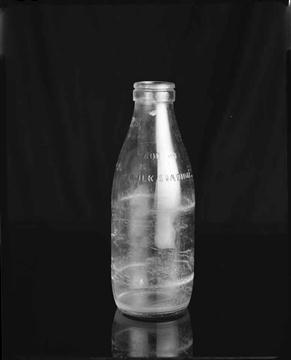 |
| HARUS PHOTOGRAPH Great lighting and you can see the reflection . Looks very clean and professional. |
 |
| My photograph of an old milk bottle. In this image I did not use lighting which now I wished I did. I tried to get a similar back ground so I used a black rubbish bag which was too shinny , I didn't think to use perhaps a black material perhaps velvet or similar. In Harus photograph the milk bottle must of sat on a glass table top because you can see the reflection in my case I was hoping the black shinny rubbish bag would have accomplished the same but it didn't. Perhaps had I used lighting I may have achieved that. |

If I was to reshoot both images I would look for perhaps a black sheet or curtain or velvet not a material that is shiny , crop the photo better and try harder to clean my objects. The bottle had held paint in it and I couldn't find the turpentine . So definitely get better materials, do some research perhaps about what still photographers use . Take the time to look for my props and make sure they are clean.
Another thing I would do would be to defiantly experiment with the lighting. I wanted the bottle to stand out and be seen like Harus but it didnt.
 |
| Really needed to get some lighting involved. |

No comments:
Post a Comment